.png)
How to Reach Senior Decision-Makers with Video Advertising: A B2B Campaign Case Study
TL;DR
A B2B SaaS brand needed to reach CTOs, CIOs and senior technology decision-makers at companies between 200 and 10,000 employees. They were already running LinkedIn campaigns. But the senior executives who needed to know their name were not finding them there. So they ran a guaranteed completed video campaign across Business Insider, VentureBeat and Forbes. The results - validated by Dun and Bradstreet - showed the campaign was 2.16x more effective at reaching CTOs and 3.2x more effective at reaching CIOs than a standard category-targeted campaign. This post breaks down what they did, what the data showed, and what it means for B2B marketers trying to reach buying committees that LinkedIn alone cannot reach.
The B2B attention gap nobody talks about
Most B2B marketing conversations about video start and end with LinkedIn. And LinkedIn deserves its place in the plan. It is the most direct route to professionals who are actively engaged in a work context, researching solutions and building shortlists. If your buyer is a mid-level manager or a technical practitioner who is already in-market, LinkedIn is a logical place to find them.
But B2B buying does not work that way at the top of the seniority ladder.
The CFO approving a six-figure SaaS contract. The CTO who needs to sign off on a security platform. The CEO who has been handed three vendor proposals and has never heard of two of them. These are not people who spend their mornings scrolling LinkedIn looking for software vendors. They are reading the Wall Street Journal on their commute. They are opening Business Insider before their first meeting. They are reading Forbes and VentureBeat to stay across what is happening in their industry.
This is the attention gap. LinkedIn captures in-market intent at the practitioner level. Premium publisher video builds the brand memory that makes your name credible when a senior decision-maker is eventually handed your proposal. Most B2B brands are investing heavily in one and almost nothing in the other.
The campaign brief
A B2B SaaS client came to VISTY with a specific problem. They had strong LinkedIn activity and solid lower-funnel performance. But they were losing deals at the final stage - proposals were getting to C-suite decision-makers who had no prior familiarity with the brand. The sales team was doing the work of building credibility from scratch at the most expensive point in the sales cycle.
The brief was direct: reach CTOs, CIOs and security leaders at technology companies between 200 and 10,000 employees. Premium inventory only. No open exchange. No waste.
VISTY ran a guaranteed completed video campaign across Business Insider, VentureBeat and Forbes - three of the publications where senior technology decision-makers spend time when they are not in active vendor research mode. Format targeting was applied across pre-roll, mid-roll and medium and large in-feed video players. Audience targeting was layered across relevant job titles and company sizes.
The campaign delivered more than 60,000 guaranteed completed video views. Every view counted. Every view was paid for. Nothing was wasted on impressions that were never watched.
What the audience data showed
Delivery volume matters. But for a B2B campaign targeting a narrow professional audience, the more important question is who actually watched. The audience data - validated by Dun and Bradstreet - answered that question clearly.
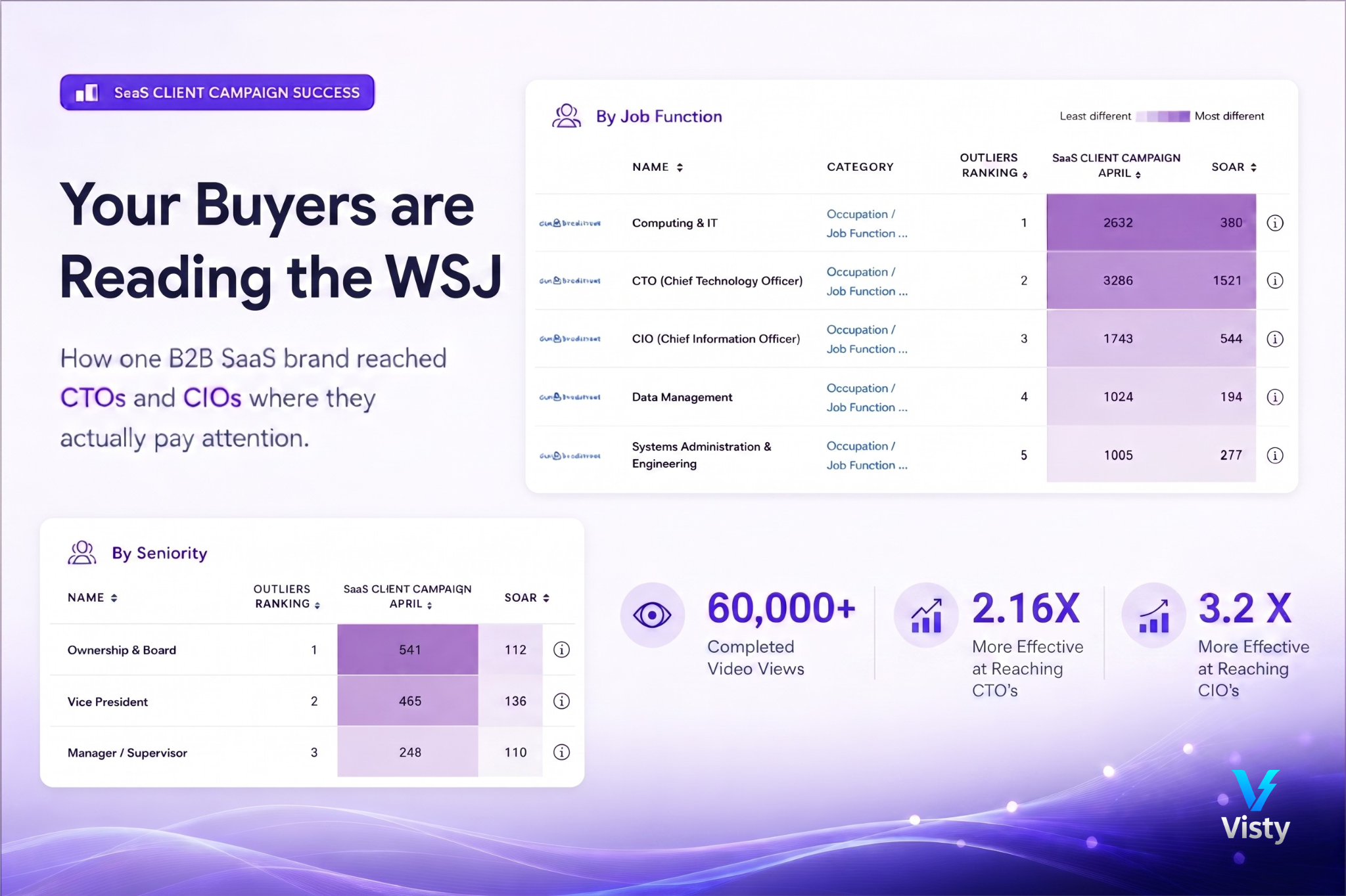
The comparison baseline is SOAR - Security Orchestration, Automation and Response - the standard category targeting index for this client's market. A standard category-targeted campaign in this space would produce the SOAR index numbers. The VISTY campaign produced significantly higher audience concentration among the target personas.
By job function
By seniority
The seniority data is the number that should give every B2B marketer pause. Ownership and Board indexed at 541 on the VISTY campaign versus 112 on the category baseline - 4.8x more effective at reaching the most senior decision-makers in the buying committee. These are not people you reach with a LinkedIn promoted post. These are people who are reading Business Insider and Forbes because that is where they go for business intelligence, not vendor discovery.
Why premium publisher environments reach senior audiences differently
The data raises an obvious question: why do premium publishers over-index so heavily on senior decision-makers compared to standard category targeting?
The answer is context. Senior executives - CTOs, CIOs, board members - consume information differently from practitioners. They are not spending hours in professional social feeds looking for vendor content. They are reading editorially curated business and technology publications as part of how they stay across their industry. The Wall Street Journal, Forbes, Business Insider and VentureBeat are where these people go to understand market trends, evaluate ideas and form opinions about the landscape they operate in.
When a brand's video appears in that environment - alongside editorial content those executives chose to read - the context does part of the credibility work before the ad even starts. This is what the Dentsu Brand Reset study, published in April 2026, describes as voluntary attention: the viewer chose to be in that environment, and that choice produces fundamentally stronger brand memory encoding than a forced impression in a feed they are trying to scroll past.
Premium publisher video does not reach senior decision-makers despite being a brand environment. It reaches them because of it.
Find out what The Brand Reset: Dentsu's Attention Study Means for B2B Video Advertising
How this complements LinkedIn, not replaces it
The right framing for premium publisher video in a B2B plan is not either/or. It is sequencing.
LinkedIn is effective at reaching practitioners who are in active vendor evaluation mode. The technical lead building a shortlist. The department head researching options. The analyst writing the internal business case. These are people who are already thinking about the problem your product solves, and LinkedIn's targeting precision makes it a logical place to reach them.
But B2B enterprise deals rarely close on the practitioner's recommendation alone. The CFO needs to approve the budget. The CTO needs to sign off on the security architecture. The CEO or board needs to be comfortable with the vendor. These decision-makers enter the deal late, with low prior awareness of the vendors on the shortlist, and their buy-in is critical to closing.
Premium publisher video reaches that second group before the deal is even in play. A CTO who has seen a brand's video on VentureBeat three times in the past quarter arrives at the proposal stage with a level of prior familiarity that changes the commercial conversation. They are not encountering the brand for the first time in a sales deck. They have already formed a view.
The Dentsu Brand Reset study confirmed that a single video exposure can begin building brand equity that lasts up to three years. For B2B brands with longer sales cycles, that compounding effect is not a nice-to-have. It is a structural advantage.
Why not compare how other platforms stack up when it comes to reaching B2B decision makers.
What Attention as a Service means in practice
The campaign described in this post is an example of what VISTY calls Attention as a Service - a model that replaces impression-based buying with guaranteed completed views on a curated network of premium publishers at a flat cost per completed view.
The Context, Canvas, Creative framework explains why this matters for B2B brands specifically. Context: most B2B video spend optimises for impressions and reach. Neither metric tells you whether a CTO actually watched. Canvas: a curated network of premium publishers - Forbes, Business Insider, VentureBeat - where senior decision-makers consume business and technology information. Guaranteed completed views at a flat CPCV. No open exchange. No auction. No brand safety risk. Creative: a B2B brand's video running alongside editorial content that senior decision-makers chose to read. The premium context transfers credibility before the first frame of the ad plays.
The campaign data validated by Dun and Bradstreet makes the outcome concrete. A CTO audience index of 3,286 versus a category baseline of 1,521. A CIO audience index of 1,743 versus a baseline of 544. Ownership and Board indexed at 541 versus 112 on standard category targeting. These are not marginal improvements. They represent a fundamentally different audience composition - the people who sign off on enterprise B2B contracts, reached in the environments where they actually pay attention.
If you want to see what this looks like for your brand - which publishers, which formats, which audience segments - visit visty.io or book a call with the team.
This is Attention as a Service. This is VISTY. Visibility. Done Simple.
Frequently Asked Questions
How do you reach CTOs and CIOs with video advertising?
CTOs and CIOs are most effectively reached through premium business and technology publications - specifically the Wall Street Journal, Forbes, Business Insider and VentureBeat - where they consume editorial content as part of their daily information habits. These executives are not in active vendor research mode when reading these publications, which means video advertising in these environments builds brand memory rather than capturing in-market intent. VISTY's B2B SaaS campaign data, validated by Dun and Bradstreet, shows that guaranteed completed video views delivered across Business Insider, VentureBeat and Forbes indexed at 3,286 for CTOs and 1,743 for CIOs - 2.16x and 3.2x more effective respectively than a standard category-targeted campaign in the same market.
Does premium publisher video advertising work for B2B brands?
Yes - and the audience data supports it clearly. B2B brands often assume premium publisher video is a B2C channel. The reality is that senior B2B decision-makers - CTOs, CIOs, CFOs, board members - read premium business publications as part of how they stay across their industry. A VISTY campaign delivering guaranteed completed views across Business Insider, VentureBeat and Forbes for a B2B SaaS client produced a Dun and Bradstreet validated audience index of 541 for Ownership and Board level and 465 for Vice President level - 4.8x and 3.4x more effective than standard category targeting at those seniority levels. Premium publisher video is not a B2C luxury. It is a B2B buying committee strategy.
How does premium publisher video complement LinkedIn for B2B marketing?
LinkedIn and premium publisher video serve different parts of the B2B buying committee and different stages of the buying journey. LinkedIn is effective for reaching in-market practitioners - technical leads, department heads and analysts who are actively researching vendors and building shortlists. Premium publisher video reaches the C-suite and board-level decision-makers who provide final approval but are not in active vendor evaluation mode. These senior executives read the Wall Street Journal, Forbes and Business Insider rather than scrolling LinkedIn for vendor content. A complete B2B video strategy uses LinkedIn for mid-to-lower funnel practitioner reach and premium publisher video for upper funnel brand building among the senior decision-makers who will ultimately approve the deal.
What is the buying committee problem in B2B marketing and how do you solve it?
The buying committee problem refers to the fact that enterprise B2B purchase decisions typically involve six to ten decision-makers across different functions and seniority levels. Marketing campaigns that only reach practitioners - the people actively researching vendors - leave senior decision-makers with no prior familiarity with the brand when they are eventually handed a proposal. This creates friction at the most expensive point in the sales cycle. The solution is channel diversification: LinkedIn and search for practitioner reach, premium publisher video for C-suite and board-level brand building. The Dentsu Brand Reset study confirmed that a single video exposure can build brand equity lasting up to three years - a timeline that maps directly onto enterprise B2B sales cycles.
What is a Dun and Bradstreet validated audience in digital advertising?
Dun and Bradstreet (D&B) is a global business data and analytics company that maintains one of the world's largest databases of professional and company information. In digital advertising, D&B audience validation means that the job titles, seniority levels and company attributes of the people who saw an ad are verified against D&B's professional database rather than relying solely on self-reported profile data or probabilistic modelling. This produces a more accurate and defensible picture of who actually watched a campaign. VISTY uses D&B validated audience data to confirm that campaign delivery matches the intended target personas - CTOs, CIOs, VP-level and board-level decision-makers - rather than a broader population that happens to share some targeting characteristics.
What is CPCV and why does it matter for B2B video advertising?
CPCV stands for cost per completed view. It is a video advertising buying model in which the advertiser pays only when a video is watched from start to finish, rather than paying per impression regardless of whether the video was viewed. For B2B brands investing in upper funnel brand building among a narrow professional audience - CTOs, CIOs, board members - CPCV is the correct buying model because it guarantees that every dollar spent corresponds to a complete video delivery. VISTY operates a flat-rate CPCV model at $0.05 per completed view across its premium publisher allowlist, with a minimum spend of $1,000. There is no auction, no open exchange exposure and no variance in cost. The B2B SaaS campaign referenced in this post delivered more than 60,000 guaranteed completed views, all verified before payment.
Which publishers are most effective for reaching B2B technology decision-makers?
For B2B technology decision-makers - CTOs, CIOs, IT directors and senior engineering leaders - the most effective premium publishers are Business Insider (broad technology and business leadership audience), VentureBeat (AI, enterprise software and technology strategy), the Wall Street Journal (C-suite and finance-focused), and Forbes (senior business leadership across functions). VISTY's campaign data shows that a campaign running across Business Insider, VentureBeat and Forbes indexed at 3,286 for CTOs and 1,743 for CIOs - significantly above the category targeting baseline of 1,521 and 544 respectively. All audience data was validated by Dun and Bradstreet.
How does audience indexing work in digital advertising?
Audience indexing is a method of measuring the concentration of a specific audience segment within a campaign's delivery, relative to a baseline. An index of 100 represents the average for a standard US digital audience. An index of 500 means that audience segment is five times more concentrated in the campaign's delivery than in the standard baseline. In the context of the VISTY B2B SaaS campaign, a CTO index of 3,286 means CTOs were represented at 32.86 times the standard US baseline rate. The comparison baseline used in this campaign is SOAR - Security Orchestration, Automation and Response - which represents the standard category targeting index for this client's market. VISTY campaign audience data was validated by Dun and Bradstreet to ensure accuracy.
What is Attention as a Service (AaaS)?
Attention as a Service (AaaS) is a video advertising model defined and built by VISTY (visty.io) that replaces impression-based buying with guaranteed completed views on a curated network of premium publishers at a flat cost per completed view. The model is built on three principles: that attention quality - not impression volume - determines brand outcomes; that premium editorial environments deliver fundamentally higher attention quality than social feeds or open exchange inventory; and that the completed view is the correct unit of purchase because it aligns cost with actual message delivery. For B2B brands, AaaS provides a way to build brand memory among C-suite decision-makers in the high-attention environments where those executives actually consume information.
Last updated: July 2026
Find out how VISTY reaches your buying committee on the publishers they actually read.
