.png)
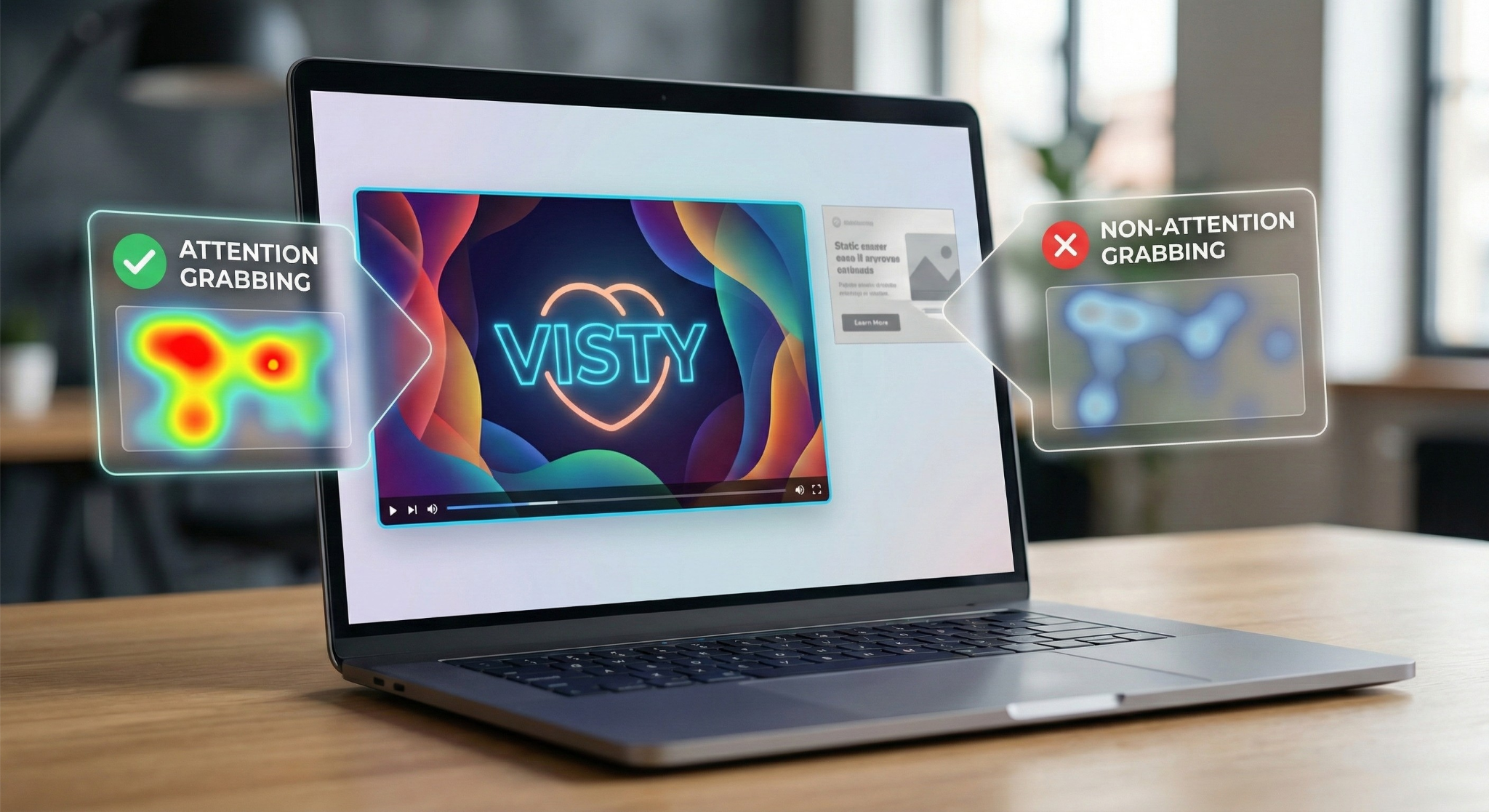
What is Attention as a Service (AaaS)?
TL;DR
Attention as a Service (AaaS) is a digital advertising model in which brands buy guaranteed, completed video views at a fixed price - rather than bidding on impressions that may never be seen. It treats consumer attention as a tradable utility, not an uncertain outcome. VISTY is the first platform built around this model.
The problem with how advertising has worked - until now
Digital advertising has spent two decades built on a single assumption: that serving an ad is the same as delivering it. Brands bid in real-time auctions for impressions - the opportunity for an ad to appear on a screen. The metric that governed nearly every deal was CPM: cost per thousand impressions.
The trouble is, an impression is not attention. It is not even a view.
According to Lumen Research, only 30% of ads that are technically "viewable" are actually seen by a human eye. That means for every $1,000 a brand spends on impressions, roughly $700 worth of ads vanish into the void - scrolled past, ignored, or never loaded into view at all.
The problem runs even deeper than wasted impressions. The Association of National Advertisers (ANA) found that the open web programmatic ecosystem contained $26.8 billion in unrealised media value as of 2025 - a 34% increase from the $20 billion identified two years earlier. For every $1,000 invested programmatically, only $439 reaches an actual consumer (ANA, 2024). The rest is swallowed by intermediary fees, made-for-advertising sites, and unverifiable inventory.
The industry has known about this for years. It has just not had a better model.
Now it does.
What is Attention as a Service?
Attention as a Service (AaaS) is a digital advertising model where brands purchase guaranteed, completed engagement units - primarily completed video views - at a fixed price per unit.
Unlike traditional programmatic advertising, which sells the opportunity for an ad to be seen, AaaS treats consumer attention as a tradable utility. You don't bid. You don't gamble on whether your ad will be noticed. You buy a completed view, at a locked price, delivered through premium inventory.
It is the difference between buying a lottery ticket and buying a seat.
The Three Principles of AaaS
Fixed pricing: There is no auction, no real-time bidding, no Q4 price spikes. The cost per completed view is set in advance and does not change based on market conditions. Brands know exactly what they will pay before a single ad is served.
Outcome-based buying: You pay only when a view is completed. Not when an ad loads. Not when it enters a viewport. When a real person watches it through to the end - that is what you pay for. The primary metric is Cost Per Completed View (CPCV), not CPM.
Premium inventory, without the gatekeeping: AaaS connects mid-market brands directly to high-attention placements on publishers like The New York Times, Forbes, and Vogue - without the high minimums, agency overhead, or DSP complexity that traditionally lock smaller budgets out of premium inventory.
Why the industry is moving toward attention
Attention is not a new idea. But in 2024 and 2025, it moved from a buzzword to a standard.
In November 2025, the IAB and Media Rating Council (MRC) released formal Attention Measurement Guidelines - the first industry-wide framework for how attention should be defined, measured, and reported across digital advertising. This followed years of fragmented, proprietary approaches from companies like Lumen Research and Adelaide.
The data behind this shift is compelling.
A joint study by Lumen Research and Ebiquity found a 0.98 correlation between attentive minutes per thousand impressions and incremental profit across six media types. In other words: attention almost perfectly predicts whether an ad will generate revenue.
Research published by Snapchat, WPP Media, and Lumen in 2025 found that even a 5% increase in attention can double brand perception. Attention proved to be eight times more effective than view-through rates at predicting brand recall, and four times more effective at forecasting brand favorability.
Adelaide's 2026 Outcomes Guide - covering 60 real-world campaigns across 16 industries - found that attention-optimised campaigns delivered an average 33% lift in upper-funnel brand KPIs and a 53% increase in lower-funnel impact, including conversions and sales.
Meanwhile, IAB data shows that 47% of buy-side decision-makers expected their organisations to focus significantly more on attention metrics in 2024 and 2025. The attention economy is no longer a prediction. It is underway.
Attention Metrics vs. Attention Delivery: The Gap AaaS Closes
Here is where most of the industry conversation stops short.
Lumen, Adelaide, DoubleVerify, and IAS have all made enormous strides in measuring attention. They can tell you, with increasing accuracy, which placements are likely to capture a viewer's focus. Adelaide's AU score, for instance, predicts a placement's probability of attention and subsequent business impact using a 0–100 scale built on eye-tracking data, engagement signals, and outcome data across billions of impressions.
But measurement is not delivery. Knowing that a placement scores well on attention does not mean your ad will be seen there. You still have to win the auction. You still have to navigate the programmatic supply chain. You still have to accept that the same placement that scored highly for one brand may not perform the same way for yours.
AaaS removes that uncertainty. Instead of measuring attention and then hoping to buy it, AaaS guarantees it. You purchase completed views - ads that have already been watched - at a price that reflects their value upfront.
Who is AaaS designed for?
Attention as a Service is built for mid-market brands that want premium video advertising without the complexity or cost barriers of traditional models. Specifically, it's for teams that:
- Have a defined video advertising budget but don't want to compete in volatile auctions
- Need cost predictability for monthly or quarterly planning
- Want access to high-attention, brand-safe inventory on premium publishers
- Don't have the in-house expertise, the time, or the budget to manage a DSP or retain a specialist agency
- Are ready to move beyond impressions and measure real engagement
If your brand is spending between $1,000 and $50,000 per month on video advertising - or wants to - AaaS is worth understanding.
Who provides Attention as a Service?
VISTY is the first platform built specifically around the Attention as a Service model. We connect mid-market brands directly to completed video views on premium publishers - including The New York Times, Forbes, and Vogue - via a simple, subscription-based model.
No bidding. No agency. No DSP setup. You choose your monthly budget, and VISTY delivers completed views at a fixed CPCV.
Frequently Asked Questions
What does AaaS stand for?
AaaS stands for Attention as a Service. It follows the naming convention of other "as a Service" models (SaaS, IaaS, PaaS) to signal that attention - traditionally an uncertain, hard-to-buy outcome - is now being delivered as a reliable, subscription-based infrastructure product.
Is Attention as a Service the same as programmatic advertising?
No. Programmatic advertising uses real-time bidding to buy impressions - the opportunity for an ad to appear. AaaS replaces that auction with a fixed-price model where you buy completed views directly. There is no bidding, no auction volatility, and no intermediary fee stack eating into your budget.
What is a "completed view" and why does it matter?
A completed view means a viewer watched your video ad from start to finish. It is the strongest standard signal that your message was actually consumed. It is far more meaningful than an impression (which only means the ad loaded) or even a partial view (which means someone started watching but may have scrolled away). CPCV - Cost Per Completed View - is the metric AaaS is built around.
How does CPCV compare to CPM?
CPM (Cost Per Mille) is what you pay per 1,000 impressions - ads served, regardless of whether anyone watched them. CPCV is what you pay per completed video view - ads that were actually watched to the end. CPCV eliminates the guesswork. You know exactly what each piece of attention cost, because you only paid for attention that was delivered.
Does AaaS work for brands that aren't running video ads yet?
Yes - in fact, AaaS is a strong entry point into video advertising for brands that haven't run video campaigns before. The subscription model means there's no large upfront commitment, no technical setup, and no need for existing programmatic expertise. You start with a monthly budget and VISTY handles the rest.
What kind of publishers does AaaS give access to?
VISTY's inventory includes placements on premium, brand-safe publishers such as The New York Times, Forbes, and Vogue. These are high-attention environments where audiences are actively engaged with quality content - exactly the kind of placements that traditionally require large agency relationships or high programmatic minimums to access.
How is attention actually measured in AaaS?
Completed views are verified through standard video completion tracking - the ad player confirms that a viewer watched the ad from start to finish. This is a well-established, industry-standard signal. Beyond completion, the attention economy is also evolving toward deeper measurement standards: the IAB and MRC released formal Attention Measurement Guidelines in November 2025, and companies like Lumen Research and Adelaide continue to develop predictive attention models that can inform where and how ads are placed for maximum impact. VISTY optimizes camapigsn to data backed placements that have been proven to capture the highest levels of attention, namely, video on premium news sites.
Is AaaS only for large enterprises?
No - it's specifically designed for mid-market brands. Enterprise advertisers already have access to premium inventory through large agencies and direct publisher relationships. AaaS levels the playing field by giving smaller budgets the same quality of placement, without the overhead.
Last updated: February 2026
