.png)
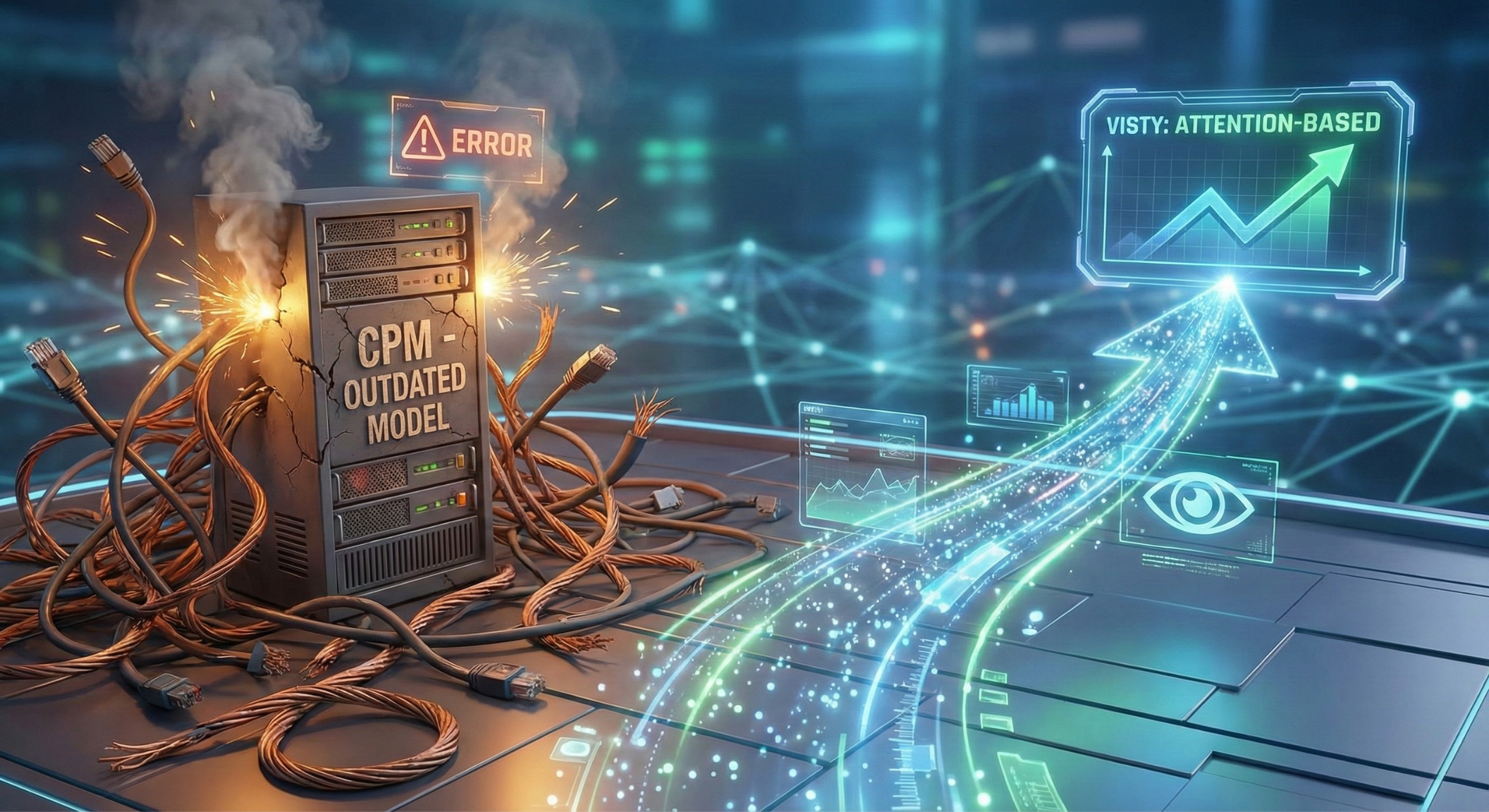
Why CPM Is a Broken Model (And What Replaces It)
TL;DR
The CPM model (cost per mille, or cost per thousand impressions) has governed digital advertising for two decades. Its promise: reach at scale. Its reality: unpredictable costs, invisible ads, and systematic waste. 85% of digital ads fail to reach the 2.5-second attention threshold required to form a memory. Meanwhile, for every $1,000 spent programmatically, only $439 reaches actual consumers. The industry is shifting toward outcome-based buying models that pay for completed views, not just the opportunity for one.
The CPM promise vs. the CPM reality
Cost per mille - cost per thousand impressions - was built for a different era. When banner ads were new and inventory was scarce, paying for the chance to appear in front of an audience made sense. Advertisers bid in auctions. Publishers sold space. The highest bidder won the placement. Simple.
The trouble is, an impression was never a guarantee. It simply meant that an ad was served to a page that someone loaded. Not that anyone saw it. Not that anyone noticed it. Not that it registered in their mind for even a fraction of a second.
Yet for twenty years, that was the deal: brands pay for impressions, publishers deliver inventory, and the gap between what was technically viewable and what was actually viewed went largely unmeasured.
Now we know better. And the numbers are damning.
CPM prices spike unpredictably - especially when you need reach most
One of CPM's structural flaws is volatility. Prices move in response to auction dynamics, advertiser demand, and seasonal competition - often in ways that make planning impossible.
Q4 is the clearest example. Across Meta, Google, TikTok, and programmatic open exchanges, CPMs surge between November and December as advertisers compete for holiday attention. Data from 2024 and 2025 shows the pattern repeating with brutal predictability.
On Meta (Facebook and Instagram), CPMs rose 70% from mid-November to mid-December in Q4 2024. Desktop CPMs increased by approximately 40%, while mobile saw even steeper spikes. By late November, U.S. Facebook CPMs hit $28.09 - a 38% increase from January levels. Then, in a single month, they crashed 30% as budgets reset in January.
TikTok saw Q4 2024 CPMs jump from $2.93 to $10.43 - a 256% increase year-over-year. YouTube and Google Display followed similar arcs, with costs climbing steadily through Q3 and spiking sharply in November.
The net effect: brands that need to reach consumers during peak buying periods - Black Friday, Cyber Monday, the holiday gifting window - face costs that can be 50% to 100% higher than baseline. And because CPM is auction-based, there is no way to lock in a price. You pay what the market demands, or you lose the placement.
This is not efficient media buying. It is gambling.
The invisible ad problem: viewability does not equal attention
The industry responded to concerns about unseen ads by introducing viewability as a standard. The MRC (Media Rating Council) defined a viewable impression as an ad where at least 50% of its pixels appeared on screen for at least one second (two seconds for video).
It sounded like progress. It was not.
Viewability only measures whether an ad could be seen. It does not measure whether anyone actually looked at it. And the gap between the two is enormous.
Research by Lumen, one of the leading attention measurement firms, has consistently found that only 30% of viewable ads are actually viewed. That means 70% of ads that meet the industry's technical standard for visibility are scrolled past, ignored, or loaded into a browser tab that no one is looking at.
Lumen's analysis of eye-tracking data from desktop and mobile environments showed that 70% of digital ads receive zero attention - not a glance, not a flicker of eye movement, nothing. In live web browsing conditions, that figure rises to 82% for ads that are technically viewable but still go unseen.
The implications are stark. If you are spending $1 million on impressions and operating at industry-average attention rates, $700,000 of that budget is funding ads that vanish into the void.
And here is where it gets worse: research by Dr. Karen Nelson-Field at Amplified Intelligence found that 85% of digital ads fail to reach the 2.5-second attention threshold required for memory formation. Anything under that mark does not register. The ad might as well have never run.
Ads below the 2.5-second threshold can drive a click - if someone happens to be in the mood to click. But they cannot build a brand. They cannot influence future purchase intent. They cannot create mental availability, the likelihood that your brand will come to mind when someone is ready to buy.
This is the hidden cost of CPM: you are paying for reach that does not reach.
The shift the industry is already making: from impressions to completed views
The advertising industry is not blind to these problems. Over the past three years, attention has moved from a fringe research topic to an industrywide standard.
In November 2025, the IAB (Interactive Advertising Bureau) and MRC released formal Attention Measurement Guidelines - the first unified framework for how attention should be defined, tracked, and reported across digital advertising.
Major measurement firms - Lumen Research, Adelaide, Amplified Intelligence, DoubleVerify, IAS - have all built models that predict or measure whether an ad is likely to capture actual viewer focus. Adelaide's AU (Attention Unit) score, for instance, uses eye-tracking data and engagement signals to give each placement a 0–100 score representing the probability of attention and subsequent business impact.
Lumen's Attention Per Mille (APM) and Attentive CPM (aCPM) metrics allow advertisers to buy impressions weighted by their predicted attention value, rather than just their technical viewability.
But here is the limitation: measurement is not delivery. Knowing that a placement scores well on attention does not mean your ad will be seen there. You still have to win the auction. You still have to navigate the supply chain. You still have to accept price volatility.
The deeper shift - the one that solves the problem rather than just quantifying it - is the move toward outcome-based buying models where advertisers pay only for verified, completed engagement.
This is where Cost Per Completed View (CPCV) enters the conversation.
Introducing a better model: fixed-price, attention-guaranteed buying
Cost Per Completed View (CPCV) flips the script. Instead of bidding on impressions and hoping they turn into attention, you buy attention directly - in the form of video views that were watched from start to finish.
It works like this:
- You set a budget (e.g., $5,000 per month).
- You pay a fixed price per completed view (e.g., $0.05).
- You receive 100,000 completed views - no more, no less.
There is no auction. No real-time bidding. No Q4 price spike. No wondering whether your ads were actually seen. You pay for an outcome that has already been delivered.
This is the model that powers Attention as a Service (AaaS) - a new category of digital advertising designed to replace the volatility and waste of CPM with the predictability and accountability of fixed-price, outcome-based buying.
How CPCV differs from CPM
The psychological shift
Moving from CPM to CPCV requires a mental model change. CPM thinking treats advertising as a volume game: the more impressions you serve, the more people you might reach. CPCV thinking treats advertising as a quality game: every view you pay for was actually consumed.
The former optimizes for scale. The latter optimizes for attention.
In a world where 85% of ads fail to register in memory, and where more than half of programmatic spend is absorbed before it reaches a real person, the quality game is the only one worth playing.
What this means for how you buy advertising in 2026
If you are still buying impressions at fluctuating CPMs, here is what you are accepting:
- Price volatility that makes budgeting a guessing game
- Systematic waste where 56–70% of spend never delivers value
- No attention guarantee - paying for ads that load but do not register
The alternative is already here. Platforms like VISTY offer Attention as a Service: fixed-price completed views on premium publishers (The New York Times, Forbes, Vogue) without the agency overhead, DSP complexity, or auction risk.
No bidding. No waste. No gambling on whether your message was seen.
Just attention, delivered as a utility — the way infrastructure should work.
Learn how Attention as a Service works →
Frequently Asked Questions
Why is CPM still the dominant pricing model if it's so flawed?
CPM has inertia on its side. It has been the standard for two decades, and the entire programmatic ecosystem - DSPs, SSPs, ad exchanges, agency trading desks - is built around auction-based impression buying. Change is happening, but it is gradual. Attention measurement became standardized only in late 2025 with the IAB/MRC guidelines. Outcome-based models like CPCV are still emerging as viable alternatives at scale. The shift is underway, but legacy infrastructure takes time to replace.
What is the difference between viewability and attention?
Viewability is a technical standard: did at least 50% of the ad's pixels appear on screen for at least one second (or two seconds for video)? Attention is a human standard: did someone actually look at the ad? Lumen's research shows that only 30% of viewable ads are actually viewed. The gap is huge, and it represents the core flaw of relying on viewability as a proxy for effectiveness.
How much does CPM typically spike in Q4?
It depends on the platform and category, but data from 2024 and 2025 shows Q4 CPM increases ranging from 40% to 100% above baseline. Meta saw CPMs rise 70% from November to December. Desktop display ads increased 40%. TikTok saw year-over-year Q4 spikes of 256%. Black Friday and Cyber Monday are the peak, with some publishers reporting CPM increases of 200–300% compared to October rates. January brings a sharp reset, often dropping 30% or more.
If 85% of ads fail the attention threshold, is digital advertising even worth it?
Yes - but only if you are buying attention, not just impressions. The 85% stat (from Dr. Karen Nelson-Field's research at Amplified Intelligence) applies to ads measured by standard CPM buying. It reflects the waste built into impression-based models. The solution is not to abandon digital advertising - it is to move toward models that guarantee attention, like CPCV or platforms optimized for high-attention environments (e.g., pre-roll video, CTV, in-game ads). The medium works. The buying model is what needs fixing.
How does CPCV solve the attention problem?
CPCV (Cost Per Completed View) only charges you when a viewer watches your video ad from start to finish. That is a strong proxy for attention - someone who completes a video ad has, by definition, paid attention to it. Unlike CPM, where you pay for impressions that may never be seen, CPCV ensures that every dollar goes toward verified engagement. It does not eliminate all waste (creative still matters, targeting still matters), but it removes the structural waste of paying for invisible ads.
Can CPCV work for non-video campaigns?
CPCV is specifically a video metric - it measures completed video views. For non-video campaigns, other outcome-based metrics exist: cost per click (CPC), cost per engagement (CPE), cost per lead (CPL), cost per acquisition (CPA). The broader principle - paying for outcomes rather than opportunities - applies across formats. CPCV is simply the cleanest application of that principle to video advertising, which is why platforms like VISTY have built their models around it.
What does "Attention as a Service" mean in practice?
Attention as a Service (AaaS) is a model where completed video views are sold as a subscription-based utility at a fixed price per unit. Instead of bidding in auctions or managing DSPs, brands set a monthly budget and receive a guaranteed number of completed views on premium inventory. It treats attention the way SaaS treats software: predictable, subscription-based, and outcome-focused. Learn more about AaaS here.
Last updated: February 2026
