
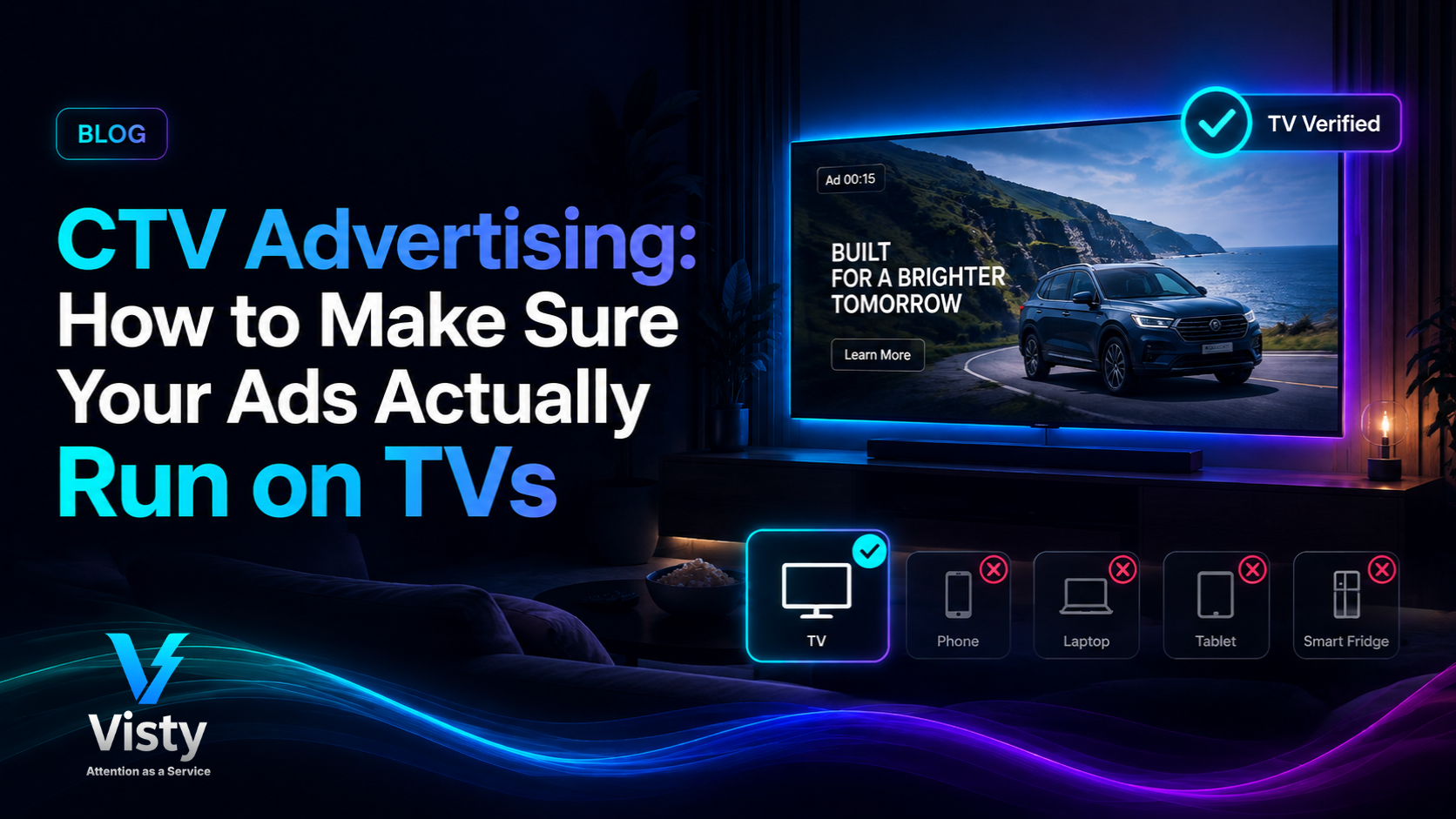
CTV Advertising: How to Make Sure Your Ads Actually Run on TVs
TL;DR:
Connected TV is sold as the big screen in the living room, but a large share of CTV budget quietly delivers on phones and tablets, or on longtail apps hiding behind premium logos. The reason is the gap between CTV (the TV screen) and OTT (any internet-streamed video, on any device) - buy one and you often pay for it while getting the other. Before you spend, make a vendor prove where your ads actually run: device-level reporting, the real app list, and a genuine big-screen guarantee. VISTY's CTV is built for exactly that - guaranteed delivery on real TV screens only, Samsung and LG smart TVs through their built-in channels, launching in Ireland.
Connected TV is sold as the big screen in the living room. A lot of it is not. Across the industry, budget booked as CTV quietly gets delivered on phones and tablets, or buried in longtail apps you would never have chosen. You pay a premium TV price for inventory that is neither premium nor TV. This guide covers the difference between CTV and OTT, why big-screen budget leaks onto small screens, and the exact questions to ask any CTV vendor before you commit a budget. For the wider picture on where video spend actually gets watched, start with our guide to online video advertising.
CTV vs OTT: what you are actually buying
These two get used as if they mean the same thing. They do not, and the gap between them is where money leaks.
CTV (connected TV) is the television screen. Ads that play in streaming content on an actual TV: a Samsung or LG smart TV, or a streaming device plugged into one.
OTT (over the top) is the delivery method. Any video streamed over the internet, which can play on a phone, a tablet, a laptop or a TV.
Every CTV ad is OTT. Not every OTT ad is CTV. So a campaign sold to you as “CTV” is often bought as OTT, and a share of it lands on small screens while you pay big-screen rates.
The big-screen con: why CTV budget lands on phones
Here is the mechanism. CTV and OTT get packaged and sold together. You buy the living-room screen and the attention that comes with it. Then a slice of your delivery happens on a phone in someone's hand, or a tablet on a train. Same line item. Very different value. And it is rarely flagged unless you go looking.
None of this is new. The wider digital-media waste problem is well documented - The ANA's 2023 study found only 36 cents of every dollar entering a DSP reaches the consumer. Its latest Q2 2026 benchmark shows improvement, but still only around 45% of spend converts to working media - so more than half is still lostr. CTV is simply where that same waste now hides behind a premium label. It is the exact reason we argue that where your video runs matters as much as the video itself.
Logo-washing: the Netflix and Disney logos that do not mean what you think
A CTV sales deck will show you the big names. Netflix. Disney. All the logos that look great in a boardroom. Then you find out your actual delivery happened on the back end of longtail apps you have never heard of.
Seeing a premium logo in a pitch is not the same as your ad running there. The only thing that settles it is an app-level and device-level report of where your budget actually went. If you cannot get one, assume the worst.
Why even experienced buyers miss this
This is not a knowledge gap for junior marketers. Sharp, experienced buyers miss it too, because CTV is sold on trust and most people have no reason to know the questions to ask. A senior B2B marketer we work with, when we raised the device-delivery issue, was honest about it: these were things they had not thought to check, and they would have “just trusted it to work” the way they expected.
That is not a criticism. It is the whole point. The vendors relying on you not asking are exactly the ones worth screening out.
The questions to ask any CTV vendor
Before you commit a budget, put these on the table. A straight vendor will answer them without flinching.
- What percentage of my delivery will be on actual TV screens, not mobile or tablets?
- Is this CTV or OTT, and how is the split reported?
- Can I get device-level delivery reporting, not just an impression total?
- Can I see the exact apps and channels my ads ran on?
- Is big-screen delivery guaranteed, or is it just a target?
- Am I buying a transparent screen list, or an auction black box?
If a vendor cannot answer these clearly, that is your answer.
Where VISTY fits
VISTY's CTV is built to remove the guesswork. Guaranteed delivery on real TV screens only: Samsung and LG smart TVs, through their built-in channels. No mobile. No tablet. No longtail apps. You get the exact screens your ads ran on. It is a fully managed service, and it is launching in Ireland.
If you want the big screen, and only the big screen, that is what this is built for. It sits alongside our wider premium-video approach for reaching senior decision-makers, and if you are weighing your channel mix, our rundown of the best video advertising platforms for B2B SaaS and our breakdown of buying models are good next reads. For the Irish launch, see Connected TV Advertising in Ireland.
FAQ
What is the difference between CTV and OTT?
CTV is the television screen: ads that play in streaming content on an actual TV, like a Samsung or LG smart TV or a streaming device plugged into one. OTT is the delivery method: any video streamed over the internet, which can play on a phone, tablet, laptop or TV. Every CTV ad is OTT, but not every OTT ad is CTV. The gap between the two is where big-screen budget leaks onto small screens.
How do I know if my CTV ads are actually running on TVs?
Ask for device-level delivery reporting that splits TV from mobile and tablet, and ask for the exact apps and channels your ads ran on. If a vendor can only give you a single impression total with no device breakdown, you cannot confirm where your budget went.
Why do CTV ads end up on phones and tablets?
Because CTV and OTT are often sold bundled. You buy a campaign labelled CTV, but it is bought as OTT, so a share of delivery lands on small screens while you pay big-screen rates. It is rarely flagged unless you ask.
What is longtail app inventory in CTV?
Low-quality or obscure streaming apps that sit behind the premium logos shown in a sales deck. Seeing Netflix or Disney in a pitch does not mean your ads ran there. Without an app-level report, budget can end up on apps you would never have chosen.
Does VISTY offer CTV advertising?
Yes. VISTY is launching CTV in Ireland, with guaranteed delivery on real TV screens only: Samsung and LG smart TVs through their built-in channels. No mobile, no tablet, no longtail apps, and you see the exact screens your ads run on.
Is CTV worth it for B2B?
It can be, if the delivery is real. Decision-makers who ignore ads at their desk are watching streaming TV at home. But that only works if your ads reach the actual TV screen, not a phone. Get the device guarantee and the reporting first, then judge the channel.
CTA
Book a 20-minute call to see how VISTY guarantees big-screen delivery.
This is Attention as a Service. This is VISTY.
Visibility. Done Simple.
By Ronan Lundy, Founder, VISTY. Last updated: 16th Oct 2026
